Sunday, January 30, 2011

Restaurants: The Butcher's Hook, Fulham

The Butcher's Hook, 477 Fulham Road
There are few things in life I love to hate more than Chelsea Football Club. Had I known anything about The Butcher’s Hook when I selected it, more or less randomly, from The Good Food Guide 2011, I likely would have reconsidered my choice. That would have been a shame, because this is a superior gastropub.
If you are as ignorant as I was, here’s a little background: The Butcher’s Hook sits at the corner of Fulham Road and Holmead Road in Fulham, directly across the street from the Stamford Gate (east) entrance to Chelsea FC’s Stamford Bridge[1] stadium. In 1905, the pub on this site was called The Rising Sun, and it was here on March 10 of that year that Henry Augustus Mears and Frederick Parker founded Chelsea Football Club. Indeed, The Butcher’s Hook hosted the Chelsea FC centennial celebration shortly after it opened in February 2005.
Wonderfully, none of this history is apparent in the pub. We arrived for a Saturday lunch to find the main room large, clean and inviting, with simple stripped-wood floors and furniture, white walls and natural lighting muted by sheer white curtains. The tables are well spaced, giving the room an open and relaxed ambience. 
Space for the pram, and a nice cabernet, too!.
The bar was pouring two cask ales, both from Greene King; my IPA was served at the perfect cellar temperature and carbonation level. The Butcher’s Hook emphasizes its wines, however, having been named the Best Wine Pub for 2008 by The Publican. They do have a large and varied wine list, with many selections also available by the glass and 500 ml carafe. The menu suggests wine pairings with several of the starters and mains.

The Butcher’s Hook describes its menu as having a “strong British slant,” and perhaps many of the dishes have roots in traditional British cuisine, but chef Jacky Lelievre’s French roots are plain to see in the preparations.

Delicious mushroom & gorgonzola pie.
 As we often do for lunch at a new restaurant, we chose to sample and share a variety of starters. We were pleased with all four; three of the four were excellent. The standout dish for me was the mushroom and gorgonzola pie; the mushrooms were musky and meaty and blended perfectly with a restrained, creamy gorgonzola; the pastry crust was flawlessly light and airy, vanishing in one’s mouth to leave a hint of texture and flavor. The confit pig cheeks were rich and tender, the crispy onions and lentils accompaniments giving it depth and range at each end of the flavor scale. The beer-battered whiting goujons[2] were light and crispy and delicious. Only the Old Spot port and sage terrine wasn’t exceptional—but it was still quite good, particularly with the caramelized onion marmalade. Even the basket of sourdough bread that preceded the meal was deliciously tart and crusty and notably superior.

The one flaw in the meal was dessert. Heidi had an own-made hokey pokey ice cream. The flavor was bland—on par with a generic supermarket vanilla—and the texture icy.
I have complained about gastropub service in the past; I have no such complaints about The Butcher’s Hook. The room was rather crowded by the end of our lunch, with one very large party occupying much of our server’s time. Nevertheless, she remained responsive and helpful throughout our meal, and the serving staff generally was quick and friendly.
Overall, we had a very positive experience and would happily return to The Butcher’s Hook—its unfortunate connections to Chelsea FC notwithstanding!!


[1] The name of the stadium has nothing to do with the famous Battle of Stamford Bridge in 1066, which occurred nowhere near here. If you are curious how the stadium got its name, the story is on the Chelsea FC website.
[2] “Goujon” is, essentially, an upscale restaurant word for “fish finger.”

Butcher's Hook on Urbanspoon

Wednesday, January 26, 2011

On Hampstead Heath: Golders Hill Park

We begin our exploration of Hampstead Heath in Golders Hill Park, 36-acres of manicured lawn and formal gardens appended to the Heath’s northwestern tip. Laid out in a rough triangle between West Heath Drive and North End Road, the Park is demarcated from the forested West Heath by a wide pedestrian path called Sandy Road. Technically, nearly all of the Park lies outside of Hampstead in the Borough of Barnet, but we don’t let that bother us too much.
History
The Park was not always part of the Heath. The Golders Hill estate was created in the 1760s by businessman Charles Dingley, an associate of William Pitt the Elder (namesake of Pittsburgh, Pennsylvania, and father of the long-serving British Prime Minister, William Pitt the Younger). A later owner, John Coore, hired one of the great English landscape architects, Humphry Repton, to landscape the property.
Golders Hill Park in relation to Rosecroft Avenue (bottom right) and the West Heath

Golders Hill Mansion, c. 1905
The last owner of the estate was Queen Victoria’s surgeon, Sir Spencer Wells. After Wells died in 1897, the estate was put up for auction. No one bid the reserve price, however, and a second auction was held in 1898. A committee of prominent locals raised £35,000 to buy the estate to save it from development, but the bidding exceeded that price.  Soap magnate Thomas Barrett (who is credited or blamed, depending on one's view, for inventing modern advertising) purchased the estate for £38,000 on his own account, and then sold it to the committee at that price. The park—with its Victorian mansion still intact—was opened to the public in December 1898.
The mansion stood until 1941, when it was destroyed by a German parachute mine.

Golders Hill Park Today

Golders Hill is an exceptional children’s park. There is, of course, plenty of space for play. There is a large sloped lawn in the Park’s center, dotted with aged oak trees and perfectly graded for safe-and-sane winter sledding. Much to Heidi's delight, there are two playgrounds, one reserved for children under 5. Hopefully, we will still be living here when Jack is old enough to use it.
View from the walled garden toward the bandstand
There is also much to explore in Golders Hill. On the West Heath Drive side of the Park, a hilly path follows a brook down to a water garden, culminating in a large pond—imaginatively called Swan Pond—that serves as home to  several swans. On the North End Road side of the Park is a lovely walled garden with an arched bridge, a small pond that is home to a number of ducks and geese, and several sculptures. A cafĂ© now stands on the site of the original mansion; by all accounts, it serves decent Italian food and very good own-made ice cream. There is a bandstand that, in the summertime, is a venue for live music.
Between these features are, for many, the Park’s two main attractions—a large enclosure that is home to a dozen or more deer, and a small zoo and aviary that houses a butterfly house, a huge owl and some very cute small mammals, including several  coati and four lemurs.
Here are some photos from two afternoons at the Park. Push play to enjoy the show:
_____________________________
References:
A. Farmer, Hampstead Heath (1984).

Sunday, January 23, 2011

Exploring Hampstead: Frognal, Pt. 3

Redington Road/Templewood Avenue
This final entry on the Frognal area of Hampstead focuses on Redington Road and Templewood Avenue, both part of the Redington/Frognal Conservation Area. Redington Road is one of the longest streets in the area, curving generally westward from Frognal past Heath Drive, then turning back to the northwest to terminate at the Heath. Templewood Avenue branches off from Redington, just west of Heath Drive, then parallels Redington’s path up to the Heath.

The Frognal end of Redington Road was among the earliest developments in the area, dating from the mid-1870s. The Heath end of Redington and Templewood Avenue contain some of the grandest and most expensive homes in the Frognal area, many worth substantially more than £10 million.


1 Templewood Gardens
As far as I know, there is nothing architecturally or historically significant about this home; I just like it. Unlike most of the homes in the area, this is on a large, open corner lot—two corners, in fact, one on either side. There are no walls, hedges or trees to block your view. This is now the residence of the Malaysian ambassador to the U.K., one of three ambassadorial residences that I know of in the Frognal area.


15 Templewood Avenue
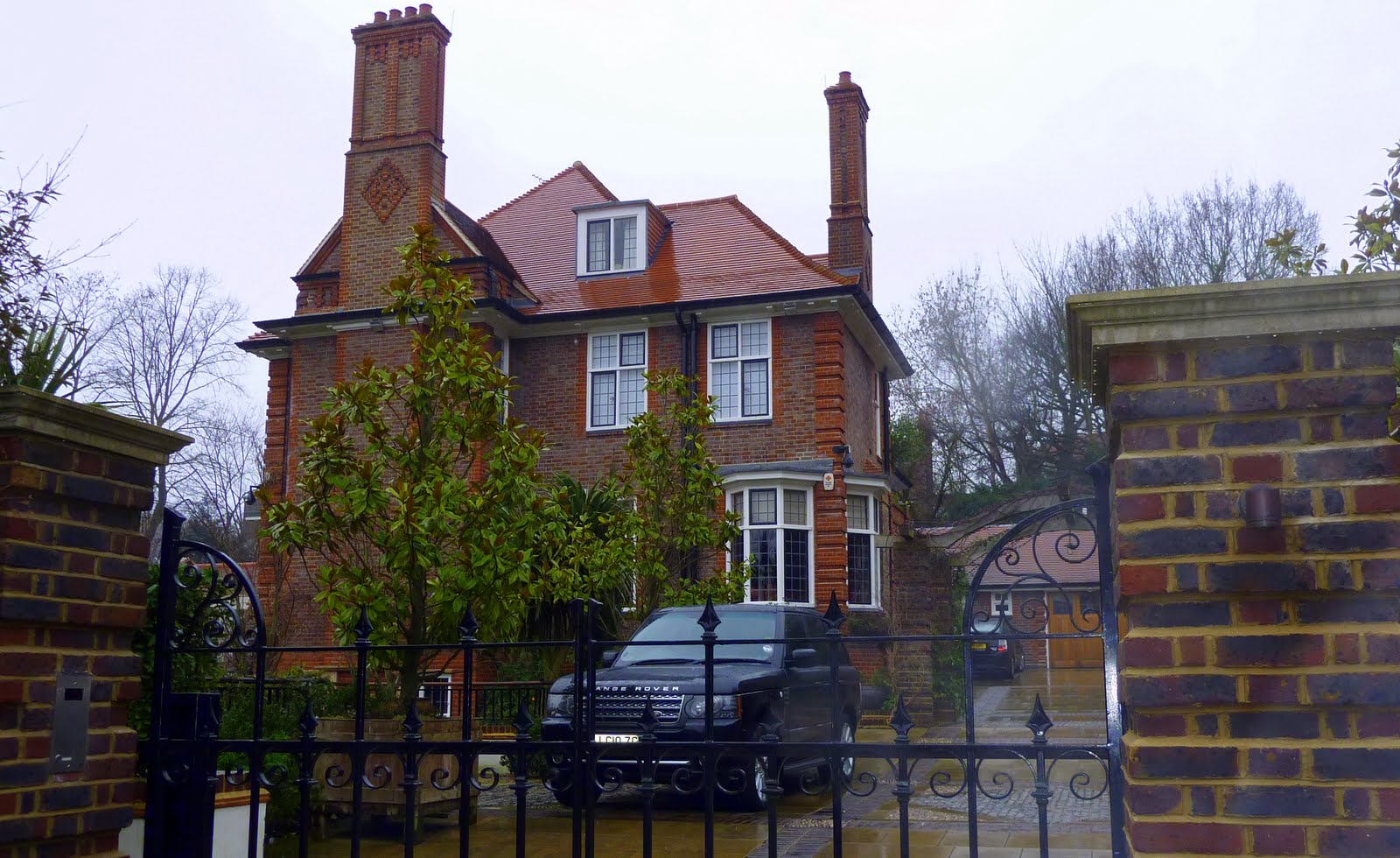
Looking at the photograph, you might think this a charming house built of pretty plum-colored brick with a nice tiled roof and attractive rusticated quoins, perhaps worthy of its Grade II listing. You’d be right, but you’d also be missing most of the story.
Take a look at the bird’s eye view below (from Bing.com). Yep, that enormous mansion is the same house, most of it invisible from the street because the house was built at a right angle to, rather than facing, the road. Two of the other houses featured in this post are similarly configured (St. John’s Vicarage at No. 6 and The Wabe at No. 66, Redington Road). I guess architect C.H.B. Quennell hadn’t heard the term “curb appeal” when he designed this house in 1905.

Bird's Eye View, 15 Templewood Avenue
The original house has been modified and expanded, of course—for example, I rather doubt that the massive two-level solarium running along the back wall was an original feature. A 2001 newspaper article described the house as “a four-storey, 8,200 sq ft home on a double plot, with 9/10 bedrooms . . . .” Not mentioned, and not visible in the photograph (but visible from the street, if you peek over the wall and through the hedges) is a children’s playhouse that some less fortunate might consider a fine family home.

2-4 Redington Road
2-4 Redington Road
Development of Redington Road began in 1876 at the Frognal end with, among others, this “wonderfully subtle” pair of semi-detached houses by architect Philip Webb.  Both are listed Grade II*, indicating that they are considered “particularly important buildings of more than special interest.”
At present, No. 2 is covered by scaffolding, so I have not seen it. The street view to No. 4 is obscured by foliage, but you can see it angle-on from the driveway. It is a lovely Arts and Crafts-style house of yellow brick, with a vine-covered brick arch over the entry. (The photograph is another bird’s eye view from taken from Bing.com.)

6 (“St. John’s Vicarage”) and 6½  (“The Cottage”) Redington  Road


6 (St. John's Vicarage) & 6 1/2 (The Cottage) Redington Road
A study in contrasts. The “unrepentantly Gothic” No. 6—to the left in the photo—was built in 1876 by T.K. Green as the vicarage of St. John-at-Hampstead Church. The ground floor used to have stained glass showing John the Baptist and a picture of the church. Although the stained glass is gone, the house still has a distinctly ecclesiastical tone, from the turret to the peaked entryway to the leaded glass.
No. 6 1/2—the modern house to the right—is called “The Cottage.” It was built in 2007 and designed by architect John McAslan. When the developer put it on the market for £6 million in 2008, the sales agent pitched it not as a primary residence, but merely as the buyer’s “place in London” that he or she could “just lock up and leave.”  A newspaper article about the house is available here.

16 Redington Road (“One Oak”)

16 Redington Road (One Oak)
This lovely listed home was designed in 1889 by a founder of the Arts and Crafts Movement, A.H. Mackmurdo, and according to British Heritage, was “designed in an innovative style for its date.” The interior is “noted to retain many of Mackmurdo's stylized and richly molded doorways, skirting boards, cornices and fireplaces.” I haven’t seen the interior, obviously, but even viewed from the street, the house exudes a palpable, country tranquility.

27a Redington Road

27a Redington Road
As you walk up the hill on Chesterford Gardens toward Redington Road, this one will stop you in your tracks—it is utterly unlike any of the box-of-brick homes around it. Built in 2005, this is the signature piece of Monahan Blythen Hopkins Architects. It was built with recycled or certified sustainable timber, is insulated with sheep’s wool, and has a solar-powered water heater. I must admit, though, that the copper barrel roof with the porthole-shaped window always reminds me of the submarine ride at Disneyland. The ground-to-roof window displaying a spiral staircase also is interesting. Additional and some interior photos of the house are available here, and a newspaper article touting the house as an “Eco Home” is available here. (Although the address is on Redington Road, the house fronts around the corner on Chesterford Gardens.)

39 Redington Road

39 Redington Road
Another house with a copper-domed turret, and a pretty fancy one, too—the house was aptly described as “well-embellished” in the Redington/Frognal Conservation Area statement. The house is on a corner lot at Redington and Oak Hill Avenue, so there are good views from two sides. This is the front view, showing the plaster panels in the eaves and a large plaque bearing the house number. The Oak Hill side offers a view of a balcony to the rear of the house, a two-storey bay window and a plaque bearing the date of construction, 1903.

54 Redington Road

54 Redington Road
No. 54 and its neighbor at No. 56—both designed by Quennell and built in 1908-09—are similar in style, and both are listed.  I chose No. 54 for inclusion here because  the vertical lines created by the quoins, the symmetrical two-storey bay windows, and the central line from the entry to the three-light dormer, give the house a sense of grandeur disproportionate to its size.  The early 18th Century-style scallop shell hood over the entry—an original feature—also caught my eye.

66 Redington Road (“The Wabe”)

This is another house that doesn’t present its best face to the road, but is well worth a look all the same. The house was designed and built in 1910 by William Garnett, an educator and an ardent fan of Lewis Carroll, for himself. The name, “The Wabe,” is derived from Jabberwocky:
‘Twas brillig, and the slithy toves
Did gyre and gimble in the wabe:
All mimsy were the borogoves,

And the mome raths outgrabe.
 The design of the house strives to be similarly fanciful, consisting of an eclectic mix of styles and elements. You can get some sense of this from the street view, from the juxtaposition of the country-cottage entry, the sharply angled extension to the right ending in an six-light bay window, and what appears to be a crenellated tower rising from the middle of the house. The Google Maps view from above shows an irregular polygonal house, roughly arranged around the south-facing views. If any of the original interior features are intact, this is one house I’d love to tour.


66 Redington Road (The Wabe)


81 Redington Road
This imposing Neo-Georgian structure is described by Wade as “architecturally significant,” although it is not listed. The house was built sometime between 1920 and 1927, and was designed by architect Sir Edward Maufe, most famous as the architect of Guildford Cathedral. Although situated among houses of similar size, this one conveys a gravitas its neighbors fail to muster.

81 Redington Road

For references, see Part 1 here.
Additional reference: Anderson, Modern London Houses: Camden: Hampstead, available at http://homepage.mac.com/doive/houses/hampstead.html (accessed 22 January 2011).

Friday, January 21, 2011

Restaurants: The Old Bull & Bush

Tucked away in a charming corner of North End between Golders Hill Park and Sandy Heath, The Old Bull & Bush bills itself as a “country pub and eating house.” In truth, since its renovation in 2006, The Old Bull & Bush looks and feels a lot more like an urban restaurant than a country pub—and a mediocre restaurant, at that.
The place certainly has historical pedigree. There has been a pub on the site since 1721, and the current building is Grade II listed. Artists William Hogarth (1697-1764), Thomas Gainsborough (1727-1788) and Joshua Reynolds (1723-1792) all drank here. The pub was the subject of a hit song called “Down at the Old Bull & Bush” before The Great War.
Yet one gets little sense of this history from the modern interior, and on a recent Sunday visit there was nothing about the place that felt like a “pub.” The bar has some period features—an open fireplace, an exposed beam running the length of the room, a plaster arch over the bar, a few well-worn wooden tables and benches—but they are offset by such jarring modern juxtapositions as silver metal tables with gray felt-covered armchairs, insipid charcoal drawings of wine bottles covering the walls, and cow-skin rugs reminiscent of the sort of roadside souvenir stand in the American west that hawks faux Native American jewelry to hapless tourists. The staff were promoting Bloody Marys rather than cask ales; they offered a wine list, but no beer menu. Only two casks were on, both London Pride.  A return visit on a weeknight proved better for the beer—they were pouring three cask ales, all in good condition—but the atmosphere still felt more like a modern restaurant bar, not a 300-year-old English pub.

A family Friday in the OB&B bar
Judged as a restaurant, The Old Bull & Bush gets mixed marks. The dining room has a pleasant ambiance: the black wooden tables are well spaced and provide a nice colour contrast to the light floor and walls. The indirect lighting provides a soft, comforting glow.  We sat in a cushioned banquette built into a bay window that was spacious and comfortable.
Some of the food was good. I had a side dish of wild mushrooms sauteed in garlic, and they were fresh and meaty and delicious. Our appetizer was a well conceived dish of scallops set on a bed of cold mango and mixed vegetables; the scallops were fresh and sweet, and I enjoyed the contrasting textures and flavours of the fruit and vegetables. (I thought the dish called for a better sear on the scallops, but reasonable minds can differ.) And, unexpectedly, the espresso drinks we had to finish the meal were excellent, and proved the highlight of the meal.

Ample signage, methinks
On the other hand, our main courses were very disappointing. Heidi, ever searching for mussels to equal those we had in Ballyvaughan, got a bowl of mussels so grossly overcooked they had the texture and flavor of a soapy kitchen sponge. My pan-seared duck breast was poorly executed, and turned out tough and flavourless.

The service, too, was spotty. Our server was friendly, quick and attentive—when she remembered that we were there.  Diverting her attention away from her telephone proved to be a challenge.

Overall, although there were high points, this was a disappointing dining and drinking experience at this price point.

Old Bull & Bush on Urbanspoon

Thursday, January 20, 2011

Restaurants: The Holly Bush


The Holly Bush

There is no place quite like The Holly Bush.[1] Although only meters from Hampstead tube station, the pub is tucked away on a quiet cul-de-sac at the top of Holly Mount, accessible from Hampstead High Street only by a steep stairway or an uphill climb along a narrow road.  As a result, it is an urban pub with a country-pub feel.
The building is worthy of its location.  The pub was built in 1643 as the stables of a house later owned by painter George Romney; shortly after Romney’s death in 1802, the stables were converted to a tavern, and pints have been pouring here since 1807. Artist John Constable gave an art lecture in these rooms in the early 19th Century; physicist Michael Faraday debated, by gas light, the utility of electricity. It is rumoured that Samuel Johnson and James Boswell drank here, and that the ghost of a long-departed waitress still takes the occasional food order.
The Holly Bush is now a Fuller’s pub, pouring a range of Fuller’s products on five casks, including the ubiquitous London Pride and the richer, more flavorful ESB. The drier Harveys Sussex Bitter also is available, on a sort of permanent guest-beer basis.  I have been told that The Holly Bush pours the best pint of Sussex in London; I look forward to trying to verify that claim.
The food is generally very good gastropub fare, but it can be inconsistent.  I have tried only one starter, a terrine of foie gras with chutney, that I found very pleasant for the price point.[2]  My braised venison shank was excellent—served on the bone, the meat was flavorful and tender, and the sauce thick and rich.  The steak-and-ale pie is superior, and it looks as good as it tastes.  The fish pie is smokey and creamy, packed with fresh, firm chunks of salmon and haddock. The sides and desserts have been uniformly good—the roasted vegetables in particular were sweet and cooked to the just the right texture. 
Enjoying a recent Sunday roast at The Holly Bush
On the other hand, I have had a roasted lamb breast that, although beautifully presented, was very chewy and fatty. Similarly, I found the Sunday roast sirloin tough and under seasoned—although I must disclose that both my wife and daughter disagreed, and happily gobbled up their portions.
I have been quite pleased and rather disappointed with the service, sometimes simultaneously.  For example, on one crowded Friday evening during the Christmas season, we booked ahead through Toptable, but The Holly Bush never received our reservation. Nevertheless, and despite being fully booked, the staff quickly found us a table and seated us for dinner. But then, once our food orders were taken, our server seemed to disappear—I cannot imagine how much money has been lost by The Holly Bush and other gastropubs because servers infrequently (or never) return to take additional drink orders while diners are waiting for their food. If a pub is going to adopt a restaurant table-service model and charge restaurant prices, its diners have every right to expect restaurant-quality service.
And one more small complaint, while I’m at it—can someone please turn down the heat?! The place is unbearably hot, in both the front and back rooms, far too often.
That said, I have been very pleased with my experiences at The Holly Bush, and it has become our default local option for both a pint and a meal.  I recommend it highly.


[1] For my impressions of The Holly Bush as a pub-crawl destination, see my post here.

[2] I qualify my evaluation of the foie gras by price point because, perhaps unfairly, I cannot help but compare this dish to the transcendent terrine of foie gras de canard served at Thomas Keller’s Bouchon Bistro in Beverly Hills, which is the most delicious thing I have ever eaten.


Holly Bush on Urbanspoon